
We mostly focus on individual companies as we think of the capital market as “a market of stocks, not a stock market.” The normal course of economic action is for people to work and companies to produce goods and services, thereby providing a return on capital and causing stock prices to rise, on average. We think this state of affairs may change temporarily.
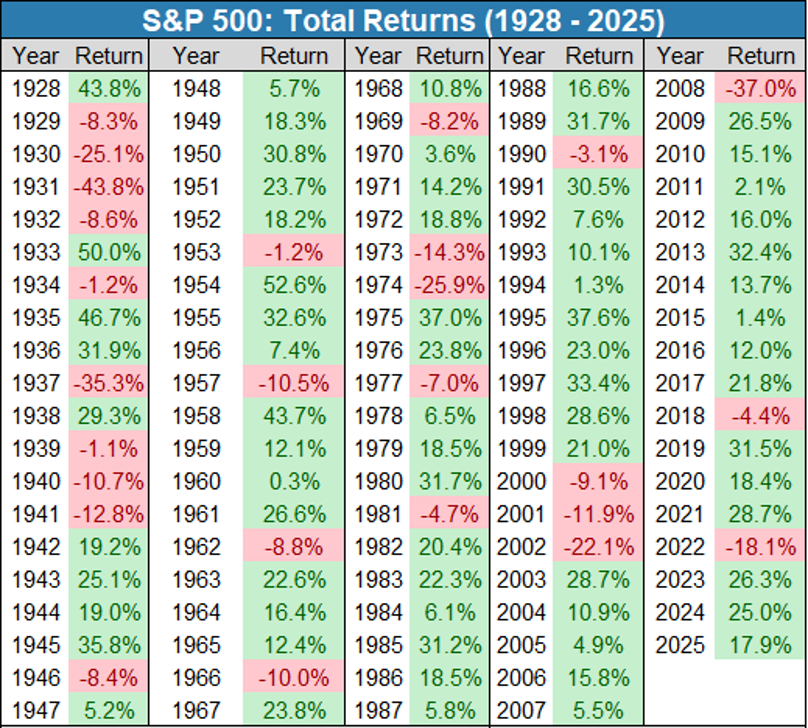
The stock market gives us a positive annual rate of return about 73% of the time. It is nearly flat about 4% of the time and down about 23% of the time. These historical experiences tell us that it does not make sense to sell the market, as one is likely to be wrong. For those with a bearish tilt, one is usually more successful making bearish bets on way-overpriced, money-losing companies.
Today, we want to raise a warning flag, as we believe the bear market in bonds is probably in the 7th inning. But that does not mean the worst is behind us. On the contrary, the market often inflicts its greatest pain at the end of the move. This happens for behavioral reasons. People tend to hold on to losing investments, hoping for a recovery that lets them exit them with little or no pain. This works when markets are in mean-reverting mode. But when markets are in a repricing phase, strong trends emerge that are devastating for those misaligned with them. Trends typically become exhausted when prices move to an extreme far beyond what most expect.
The government is clearly concerned about interest rates, as it is buying back long-dated bonds. This has more to do with signaling than substance, as they are trying to discourage people from selling. But we view this as a lost cause as the government has to sell $2 rillion in bills, notes, and bonds to cover the budget shortfall. It is just a matter of time for people to figure out that a bond buyback will not work. When that happens, we see the 30-year US Treasury bond market undergo a flush, pushing long-term yields up to 6.5%. That will knock prices down by 20%.

We do not leave out the possibility of something worse. So what might cause people to throw in the towel on long bonds? Is a word, inflation. M2 money grew 5.4% over the last year, and government debt is growing by 5% a year and is more likely to rise than fall. The Mises “True Money Supply” measures grew at 8.6% overt the past year. Price inflation follows monetary inflation. Headline CPI is up 3.4% over the past year, and we think that number gets worse. We suspect it will rise into the 5-6% range in the intermediate term, as there is no political will to cut government spending.

Politicians and talking heads will want to point at something to blame for the price inflation, and we suspect they will point at the price of oil. It is worth noting that war is the biggest driver of price inflation, as resources are redirected to activities that destroy themselves and other property, reducing the supply of most goods. In the current case with the war with Iran, we see a reduction in the production and transportation of oil and distillates like diesel and gasoline (primarily) and liquified natural gas (secondarily). We are about to see the price of natural gas skyrocket due to a significant shortage in Europe. It is also causing a fertilizer shortage, which will lead to food shortages in a year or so.
In the near term, oil and distillates are the big problem. To keep oil prices down, the US has drawn down the Strategic Petroleum Reserve. The Chinese government has drawn down its reserve and even shared those stockpiles with other Asian nations. They have also reduced consumption at the margin. Every day, the above-ground stockpiles are falling.

The chart above shows that global above-ground stockpiles are falling by about 100 million barrels per month. That is about a day’s worth of oil consumption. Assuming that trend, the global stockpile is probably below 7,600 million barrels and will likely be close to 7,200 by the end of the year. It could be worse if the pipelines in Saudi Arabia cannot be repaired quickly. Since we do not see the war with Iran ending soon, we expect oil prices to continue rising. If it does not end before 2028, we think the price of oil will be close to $200 a barrel, as we will see pockets of significant shortages around the world.
This will, of course, drive the CPI sharply higher, and it will take bond yields with it. Our favorite oil-economy investments at the moment are companies involved in the oil complex. We think exploration and production companies like APA and Suncor have the biggest upside. We also like the integrated oil companies like Exxon and Standard Oil second, and we like the refiners third. The stock prices of the refiners have risen significantly over the past couple of years as refining margins have been out of this world, and their stock prices reflect this new reality. They will do well, but probably not as well as the E&P.

